Showing posts with label Rob Bell. Show all posts

Thursday, April 28, 2011

I know I'm a bit late to the Party...

...But that's ok, according to Rob Bell in Love Wins. For I have now finished the book, a little later than I imagined I would but it's here nonetheless.

To be honest, there's not much to expand upon from my post about his talk, though I can see now why the book had made a few of the questioners rather nervous- Bell does not have footnotes, so his statements can seem a lot more bold in print, in the flesh, he seems more cautious about affirming things.

But yes, the book is largely pastoral and evangelistic, rather than theological or historical. It's concerns do range wide, as he puts it 'from heaven and hell to God, Jesus, joy, violence, and the good news is better than that, among other things'. He stresses the importance of the 'now' over the 'then'; that Hell and Heaven can be a present reality, where Christ is, where Christ is not and we do our own selfish thing, and that this comes with immediate consequences rather than just being something that haunts us after death.

As for the actual matter of heaven and hell, he quotes a number of verses that are popular with Universalists, and asks what seem to me the eminently reasonable questions of 'why is forgiveness available only in this life?' and 'Does eternal torture in hell really a sign of the Loving Father' people both inside and outside the faith ask these questions, and what I tend to find, particularly with the latter is that we try to redefine love to make something completely unrecognizable in human terms, in Christlike terms to square it with the vengeful, wrathful God. Rob Bell though wants to say we don't have to do this. 'Eternity' in Hebrew thought is and 'aeon' an age, a stretch of time but not necessarily unending day after day kind of time, and it is a quality of experience- eternal punishment may be severe and purging, but potentially finite.[1] The gates of the New Jerusalem are never shut- people can travel in and out of them, into heaven or to hell, and potentially return again. There is punishment and there is misery, but it's more corrective and purposeful, often generated by our turning away from God. As far as I can see the message is not 'hell is empty' just that it can be. What does Hell mean when the God-in-man on the cross for doing nothing other than showing and teaching love; liberating, challenging disturbing love, says 'Father forgive them, for they know not what they do?'

However whilst people are kicking up a fuss about the insane notion that maybe the Son came into the world not to condemn the world, but in order that the world might be saved through him, the really provocative thing, the real break with Western Christendom, which nobody seems to have really picked up upon. It's the idea that God's love gives us total freedom. Time and again, Rob Bell asserts we can choose God or not choose God, implying it is up to us, salvation is in our own hands. The book is not comprehensive. As far as I can see there's nothing that addresses the issue of a passage like Rom. 9 11-23, which includes 'What if God, desiring to show his wrath and to make known his power, as endured with much patience the object of wrath that are made more destruction; and what if he has done so in order to make known the riches of his glory for the objects of mercy which he has prepared beforehand for glory..?'

In this passage Paul seems to be emphasizing the sovereign will of God. It was of course this passage that acted as a key to Augustine's predestinarian theology- in his experience he found that there was no way he could've found salvation by his own power - it had to be an act of God, because Augustine in his youth positively delighted in sin and evil. What's more, he found the habit was not so easy to kick once he had become a Christian either, and so concluded that the human factor in salvation was rather negligible compared to the mercy of God. This combines with the idea that God really does get what God wants - he cannot be resisted, if he opts to save you, then you will be saved just like Augustine. Of course what is clear that if it is down to God and not to humans as to who makes it to heaven, then why are their so many unbelievers? The logical answer is because God never intended to have them become believers. They are clay pots made for destruction. He would probably accuse Rob Bell of Pelagianism were they contemporaries. I don't think Rob Bell believes God would make people solely for destruction, I don't want to believe it either, but there it is. It is a question that needs answering Augustine's view has more or less set the tone for Western Christian thinking on this matter ever since, we see it in Luther and Calvin, and the reaction of Arminius.

Of course the matter is confused slightly in the 'Love Wins' because Rob does note that Jesus is bigger than religion, and that God is not limited by human institutions, creeds and ideas seems fair, but there does seem to be the prospect that people can be saved by Jesus without recognizing Jesus specifically, I'm not sure if that a conscious choice towards a Jesus-shaped good is the idea here, or whether its potentially suggesting that in fact, God is plucking people out by his choice. Given the emphasis on freedom in the whole, book I suspect it may be the former.

The other side of this freedom of course is a rather 'american' or even 'consumer' model to Christianity? Don't like what Augustine said? That's fine, plenty don't agree with him, read the Eastern Fathers instead who never had Augustine's hang ups about sin and depravity and who affirm that because we still hold the image of God (having lost the 'likeness' (Gen 1.26) in the Fall) even in a tarnished way, we still have some freedom. He openly insists Christianity has a wide number of options, you can pick them and still be 'Orthodox' in outlook.[2]

On his first trip to America, Dietrich Bonhoeffer noted that there was a distinct distaste for conflict in the theological college he was visiting, and noted they tend to put 'community' before 'confession' if they disagreed, then they agreed to disagree on the matter. He found it quite unlike his European experience. He suggested part of it stemmed from the fact that many who came to America came fleeing religious persecution, and so were hardly going to start it up again now they had arrived in the New World. Of course it wasn't really a problem to be tolerant, it was such a big place that if one disagreed they could simply move out and spread away a little bit further. It seems friendly enough, but it had and has led to a bewildering array of Christianities in America, and Bonhoeffer himself was wary of it because they couldn't all be correct- and where freedom of religion was a noble principle to uphold for the first settlers, he was concerned that with subsequent generations it had become a general assumption about religion that meant people potentially sought accord more than caring about truth.

Can some of that be seen in Rob Bell's writings? I think so- we can disagree on these matters, I'm still going call you a Chrstian, he might say. It's inclusive and welcoming and reflects the fact that we can not ultiamtely grasp God, but it's important that we never stop trying. I said that Rob Bell seems less certain of his standpoint when in person, but maybe if he really believes what he has written is the truth, then he should be ready to defend it as best he can, because if the internet has shown me one thing about this viewpoint, it is that it currently needs a lot of defending.
__________________________________________________________
[1]This particular bit of the book is probably one of the most complicated and so it's not tremendously surprising to see that those who are claiming to review the book often miss this altogether and note references to eternal punishment, seemingly not realizing that that point has been answered.
[2] Though again the issue gets confused when in the penultimate chapter he notes that believing in the 'wrong God' can lead us to doing the wrong things- Inquisitions, wars of religion and Crusades would be examples of following the wrong God- but isn't the possibility of this happening much increased if there's a reduced need to agree upon the 'right God'?

Wednesday, April 20, 2011

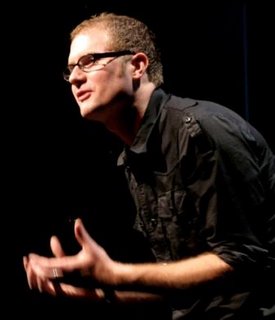
"Are you with me?" Love Wins, Cheltenham 19/04/11

As may be gathered from the title, I decided last night to head up to Cheltenham with my Father to go and hear Rob Bell, who supposedly would be talking about his latest book Love Wins- a 200-odd page volume that has made a lot of people rather cross and has had Bell denounced as a heretic (again, in all probability), this time for his views on Heaven, Hell and Afterlife, the last which seems to have been particularly contentious. The label 'universalism' has been thrown around somewhat, which I suppose is a good thing, apparently it's quite in vogue in Theology at the moment according to my tutor.

The event itself was hosted by the Greenbelt Festival organizers (self described now as an 'Arts, Faith & Justice' festival) and at the Cheltenham racecourse it did feel just like one of the festival talks. In attendance was a hearty age spread; Teenagers to pensioners, which I thought was promising. It's encouraging to know that people still want to ask deep questions about religion, that they don't want to just believe what they're told, or concentrate entirely on practical church matters. Though at one point Rob spoke of an event in the past where a guy stood up and made a really long and difficult theological point and cited 'cosmological' as a word he used. The audience found it funny, I must confess I died a little bit. It was also, I noted, Greenbelt in Microcosm; rather a lot of beards floating about on gentlemen of a certain generation, and so. much. plaid. On gentlemen of another generation.


Anyway, I'll try and focus on the substance from here on in, and chart a few of my impressions. So. It was definitely an interesting night, but I was left questioning 'What is a Rob Bell?' and all I can think of in answer is to say that, insofar as what he does at these talks, that he is not presenting himself as a teacher, or a theologian, or a controversialist. He is a story teller. A story teller that lives the story he tells with a passion. That is, the gospel story, that Christ walks amongst the broken and the sick, the 'zeroes' as he called them, Christ lives and dies and lives and loves for such as these. Indeed this is what he talked about, not about his book at all. He wanted to talk about Jesus, and did so for twenty minutes uninterrupted. It was the sort of thing that if one has any familiarity with his writing,one would recognize easily enough- in fact he even used some material that I'm pretty sure came from his Velvet Elvis. The key theme I think rested on the newness of things following the work of Christ, the break with Jewish tradition in that God maintains an outsider/insider distinction in humanity (Jew/Gentile)- that 'the Party' is for everyone, all are invited, but it doesn't stop at the invite, quite often God is there pursuing you, relentlessly, like the Shepherd and the lost sheep, or the woman and the missing coin.

Following this there was a question and answer session, whereby I think the sort of basis of his ideas became more clear, both by what he said, and interestingly by what he didn't say. One of things that he certainly never said was a direct answer to the question, no matter how basic. What we'd get instead was more stories and anecdotes, things that always had a personal quality to them. For instance there was a question about praying for the dead, his answer involved talking about the emotional healing, of the coming of terms to grief and that praying for the dead can be an unhealthy way of 'holding on'. It's not about right or wrong, whether one should or shouldn't, it starts with the individual.

This seems unsurprising in context, the definite statements that the audience teased out of him include the firm conviction that God loves everyone (as opposed to the elect) and that this love is very clearly and strongly bound to freedom, choice, human decisions. Definitely no Calvinist, Rob Bell insists that one can refuse the invitation to the Party, that you have to want to participate in heaven, salvation, whatever. This sounds to me a bit like N. T. Wright and C. S. Lewis- the idea that 'hell is locked from the inside'. Grace is resistible- God forces no-one to accept him- in fact at one point he says that 'Love Wins' because people can reject it; that people can choose to be apart form God is the triumph of Love, because Love = giving freedom. (Though I wonder what that means in the case of freedom to cause intentional harm to people...?)

What seems to be the trajectory of this freedom for Rob though, is an emphasis diversity that inevitably springs from choice. In his talk he was quite eclectic in his sources; Kierkegaard, an 18th century Hasidic tale, Francis of Assisi and C. S. Lewis all were name-dropped. He considers Christianity to be a broad stream of thought, and noted that there is barely a question about God that someone hasn't already thought about- and usually within Christianity when one is wrestling with some aspect of the faith, one can find someone else who has something to say on it; doubtless a very affirming and validating experience for us, but why (or perhaps, if) we should feel validated by this, was not touched upon. At one point a question was raised about his critics who affirmed the idea of eternal suffering and punishment in hell, and he responded that maybe that works for other people, he wasn't interested in arguing with them because he wanted to address himself to the people who were struggling with this problem.

There are as many christianities as there are christians, and there is something of an 'apophatic awareness' within his teaching, that God is not fully comprehensible to the human mind, his ways are mysterious and that to make a bold claim that one particular doctrine over all others is 'the truth' is something that cannot be said with certainty. This is where postmodernism seems to rear its head most clearly- that universal applicability and the perfect system are simply mirages. Faced with an overwhelming amount of data humans receive through improved communications infrastructure, the suggestion that there is one answer that works for everybody, everywhere, in all cultures and situations seems a notion that is somewhere between bold and incredibly foolish. Which is why he says 'Jesus is bigger than one religion', because the being that holds the whole earth together in its cacophonous, multifaceted form surely cannot be boiled down to one creed, or confession or statement.

So we don't get dogmatic lectures, we get the stories and anecdotes, we have to discover our own way, find how God communicates best with us, because things have to be context-specific. He has an aversion to systems- as he put it at one point, Jesus says he is bread of life...and you can't build a theology out of 'bread' it's just, 'bread', what is that meant to mean? But then, he says, when you're hungry, you know exactly what it means. So important does this avoidance of systematizing and generalizing seem to be, that when asked 'who influenced your thinking about this?' the answer went on for quite a few minutes but my notes state quite baldly: 'did not mention a single name'. Is it the case that we can feel validated by older Christian writers, but Rob Bell's opinions are not apparently to be treated in the same way? He's acting, I suppose, as a catalyst for your own exploration, encouraging you on, gently reminding you that God is in the questioning as much as he is in the answer.

When he reflected on it after the event, Dad suggested it was still very much 'the Gospel message, but you don't have to accept everything else on top of that' - noting that that was very different from his experiences when he was younger, when lots of things were a necessary corollary of accepting Christ- ways of interpreting scripture, eschatology moral views and so on. Possibly one could say that for Rob, doubt has its own kind of holiness, that God is in that doubt as much as he is in what one is certain of. It reminds me of something Origen said; noting that Christ appears to people depending on their capacity to receive him- whether that's as bread, or a door a healer or a teacher...whether simply a great man or God incarnate.

Truth is not relative, it's just varied.

God is for everyone, but one size of christianity doesn't necessarily fit all in the same way.

Perhaps this is why he didn't want to give too much of what was personally driving him (though compassion for the suffering and enthusiasm gospel story I would say, are clearly up there on the list) because he doesn't want people to look to him for guidance. He wants them to ultimately look to Jesus, and Jesus will appear to them as they seem fit and work with them as they need, lead them as they can be lead. One of the questioners almost accidentally called Rob 'the Saviour', so perhaps this is, on reflection, a rather prudent decision of his.

I have also purchased the book (didn't bother to wait to get it signed though) once I've finished reading it, I may return to this topic again, possibly looking more at what he says on Heaven and hell specifically, though I will also see if I need to revise any of these statements.